
I had the opportunity to staff Wood Badge course 1-609-26 as a Scribe and wrote parts of seven issues of the Gilwell Gazette.
1-609-26 just means it was the 2026 course of Chief Seattle Council (609), which is in Scouting America’s Council Service Territory 1 (Alaska, Washington, Oregon, Idaho, and Utah). Wood Badge is an adult leadership training program that happens in Scout organizations around the world. The first happened in 1919 at the Scouting headquarters at Gilwell Park near London, UK.
No matter where it occurs, each Wood Badge location is called Gilwell Field. And in the United States, the daily newsletter given to participants is the Gilwell Gazette. One of my responsibilities as Scribe was to help produce the daily Gazette.
Most of the content is about what happened the day before or is about to happen, but there’s also an opportunity for Scribes to insert a broader topic here and there. It reminds me of something I read about awhile back, a daily newsletter published for the Chicago Association of Commerce’s 1909 trip across America. I suspect that this used to be common for long events.
I contributed a few articles that I’d like to share with you. First is a recipe for cooking rice over a campfire; then, an edited article from the 1910 Seattle P-I; and finally, an article about interfaith services and the unexpected impact a Scout leader can have. They’re a bit reworked now that I have time to edit them. In particular, I think the 1910 P-I article is worth putting in every day-one Gilwell Gazette for Seattle area Scouters. And of course, I hope you get a chuckle or find some inspiration from the other two.
Gilwell Gazette day one: Campfire Rice
This is an adaptation of how I learned to do it from the Squirrel Patrol and Wood Badgers of Troop 1, Utsunomiya, Tochigi Council, Scouting Association of Japan.
Ingredients:
- Rice (1 rice measure per 2 people. It’s about 3/4 of a cup)
Instructions:
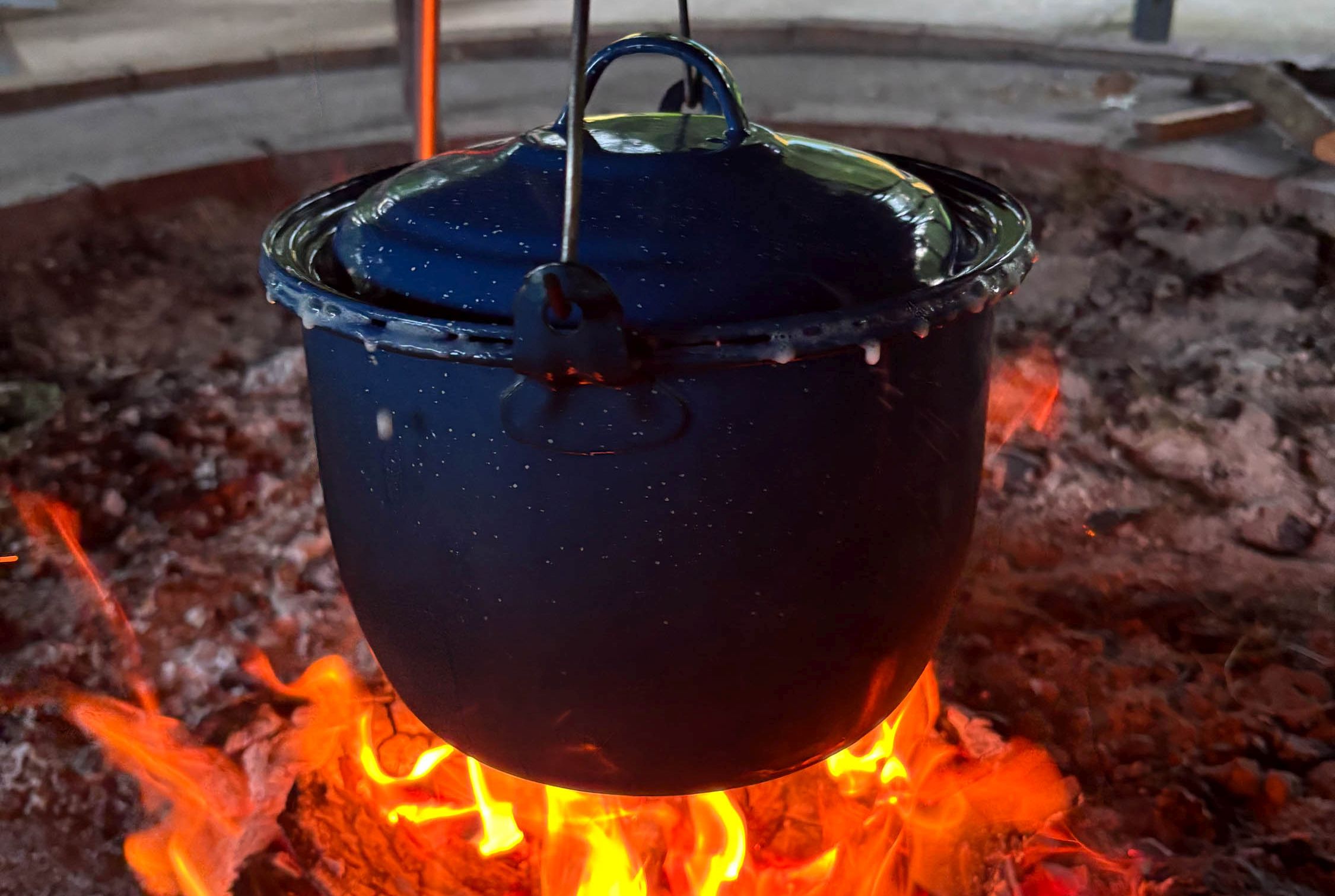
- Make a nice fire. Place a steel cooking tripod (eg, Stansport) astride the fire with chain at a height where the pot (eg, GSI 4.25 qt enamelware kettle) hangs just above the flames.
- Add rice to cold kettle. You didn’t hang the kettle over the flames already did you?
- Add water until it’s a knuckle above the top of the rice. It’s important to get the amount of water right, or the rice will be soggy or dry, but also you can just wing it.
- Hang the kettle over the flames. After putting the pot on the hook, never open the lid or you will curse your rice.
- Watch the rice. The water will start to boil, and the foamy rice bubbles will rise to the top of the pot and start to overflow. Great job making a mess, you can’t do this on a stove!
- It will stop bubbling over, but it’s not done! You need to boil off the water. You will know it is done when the pot stops vibrating. It’s too hot to touch, so use tongs or a long cooking chop stick. Place one end against the pot and listen to the other end. The rice will tell you when it’s done.
- Serve with silicone rice spoon or ladel
Gilwell Gazette day one: Seek Captains for Scouts
September 9, 1910 Seattle Post-Intelligencer
Movement Calls for Commanders of High Type of Citizenship
HONEST WORK, NO PAY
Those Who Advertise Themselves or Business Need Not Apply
Adults with real red blood in their veins, with strong character and without an ax to grind, and with the good of American youth sincerely in their hearts, are wanted to captain the great American Scout movement that is sweeping over the country.
This campaign for the wholesale, wholesome training of the nation’s future leaders, which recently came into Seattle and the Northwest under the parenthood of W. Hamilton Lindsay, of Seattle, needs more adults who, without thought of self, will organize and take command of the youngsters in their respective neighborhoods. Drill masters, who soon will become scout masters, are wanted.
Cross-Country Run Today
One hundred and twenty boys have already been recruited in Ballard, and will this morning participate in a cross country hike to Washington park. Today’s outing will be in charge of Scout Masters B. A. Clark, of Ballard; P. J. Flagg, of Rogers, and H. A. Anderson, of Collins. At the park a detail of lads will conceal themselves in the woods, leaving a trail purposely marked with conflicting signs, and the boys will endeavor to find them. The Ballard division consists of fifty boys, the Collins of thirty-five and the Rogers of thirty-five. At the present time there are nearly 300 lads connected directly or indirectly with the Scout movement in Seattle.
* Some text edited to include all current Scouts and leaders
Gilwell Gazette, day one: FUN FACT
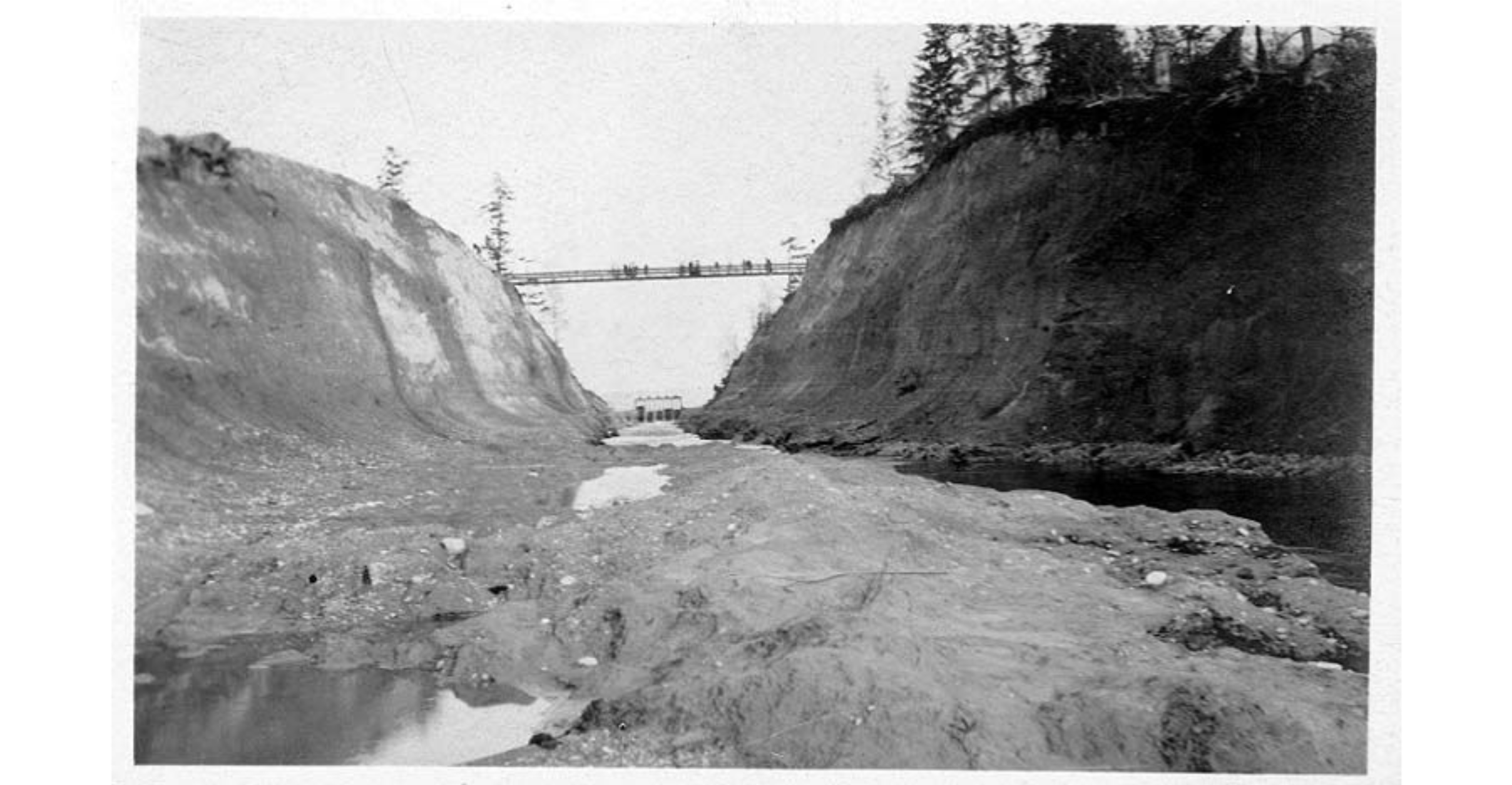
Philmont Scout Ranch is 1.5 Seattles, or 4,074 Lumen Fields
Gilwell Gazette, mid-course: The yoga of hiking
Finding vocation
1919 was the first year of summer camp at Parsons. Among the campers that year was George Nakashima from Troop 204 in Columbia City. At Parsons, Nakashima earned swimming, lifesaving, and craftsmanship merit badges. Woodworking was one of the paths to Craftsmanship merit badge, and certainly the one offered at Camp Parsons that year.
George Nakashima is now recognized as one of America’s best woodworkers during the mid-1900s. So, imagine yourself as his merit badge counselor, and then seeing a piece of his priced prized furniture for sale years later. That’s the impact you can have.
Interfaith
When he was at Parsons, Nakashima was in a troop chartered by a Methodist church, and his later troops met at Presbyterian and Baptist churches. His family were also members of a Buddhist temple and a Shinto shrine. Later, as a young architect, Nakashima traveled to India to construct a dormitory for Sri Aurobindo Ashram. While working with them, he became a devotee of the group’s spiritual practices, Integral Yoga.
Nakashima’s beliefs were, in his own words, very fluid. He later described himself as a “Hindu Catholic Shaker Japanese American”. He was his own personal interfaith service.
Because of the opportunity I had to meet his daughter, Mira Nakashima, I can make a finer point. After our discussion I saw her speak to a group of architects at the Seattle Asian Art Museum. She digressed from his life story and description of buildings and furniture to talk about something more significant. She called it the “yoga of doing”, her father’s view of karma yoga. It involves reaching a meditative state through repetitive actions like making the same clay pot over and over.
Backpacking as reverence
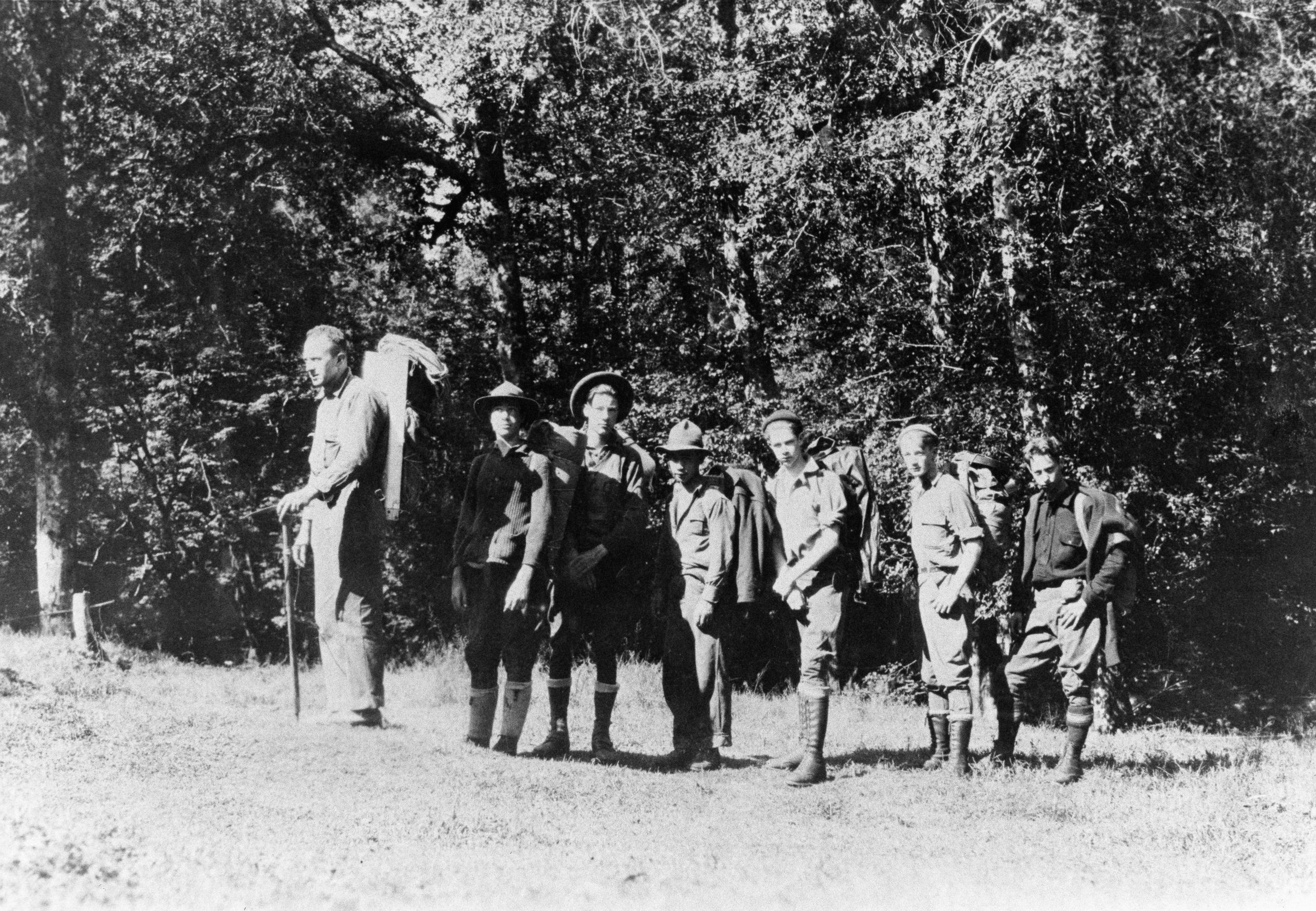
Later, Mira Nakashima gave another example from her father’s own life: backpacking. During his time as a Scout, he was one of the first hikers to travel from Parsons to the Pacific Ocean over the Skyline Trail in 1920. On these treks he would reach a physical exhaustion and rhythm of action that put him in tune with himself and the natural world around him.
Indeed, George Nakashima pointed to Scouting as the start of the reverence he found in life. In fact, the impact of the work by Scout leaders a century ago continues to resound even now in his family’s Nakashima Institue of Peace. The institute maintains his National Landmark woodworking shop, continues efforts to spread peace through beauty, and provides opportunities for personal meditation.
More I wrote
My articles on early Seattle Scouting:
- Seattle’s first Scout hike
- Seattle’s second Scout hike
- Seattle’s first patrol leaders
- Start of Scouting in Seattle
- Elmer Katayama at Camp Parson’s opening
- George Nakashima and Scouting
- Aldus Hoopman, Seattle’s first Eagle Scout
- Troop 50 to 59
My articles on early Seattle Cub Scouting:
- Cub Scouts began in Port Angeles (part 1)
- Camp DYB, 1925 Cub camp in Port Angeles (part 2)
- Wolf Cubs lost at war (part 3)
- Blue Ox Camp, Seattle’s Paul Bunyan themed camp (part 4)
- What did they sing at Blue Ox Camp? (part 5)
- Cub Scout Alphabet
Discover more from ba-kground
Subscribe to get the latest posts sent to your email.