
This is part of the story of Chester “Chet” Sakura, Seattle’s first Japanese American Eagle Scout.
First, a few words of explanation. This article appeared on page 10 of the April 2026 newsletter of the Seattle Nisei Veterans Committee.
The NVC was formed after World War 2 by Japanese American members of the 442nd, MIS, and other units due to forced segregation. As you will read, I’ve had the pleasure of joining NVC Memorial Day activities since 2019. I encountered Chet Sakura’s story while researching George Nakashima, and even had the chance to speak with his son David Sakura over zoom. I’ve intended to write something and finally pushed myself after NVC’s volunteer brunch in February.
While writing, I had no idea that Jim McDermott would be guest speaker at Memorial Day this year. Representative McDermott came up in my conversation with David Sakura, as he casually mentioned they were college roommates. Well, McDermott’s speech was entirely about his friendship with David Sakura and the impact of the Sakura family story on his worldview.
I don’t have access to a register of Seattle’s Eagle Scouts, but their achievement was published in the Seattle Post-Intelligencer. We can read them name by name for the first few years.
One last note. The regular NVC newsletter readers already know this, but I should say here that Troop 252’s connection to NVC is as the last of Seattle’s historically Japanese American Scout troops.
Finding Chet Sakura
I am grateful to the Nisei Veterans Committee for continuing to provide Troop 252 with a role in annual celebrations and memorials. For the last few years, I have served as the troop’s Scoutmaster. Outside of Scouting, another hobby I have is history, so I have been poking around in newspapers and newsletters to learn more about the community that we are a part of. I would like to share my version of a story that is already familiar, or personal, to many of you.
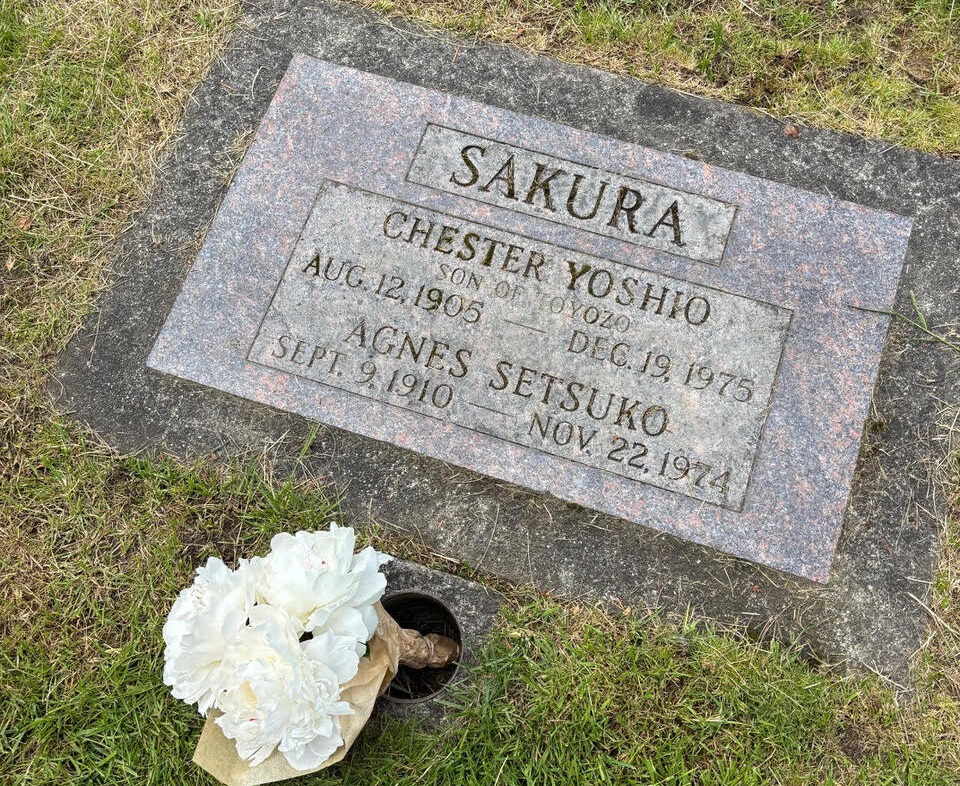
South on the access road of Nisei Veterans Committee’s Lake View Memorial Day setup, on the northeast corner at the intersection, are the graves of the Sakura family. You’ll find them at a short vertical marker in the row beyond the larger Shigemura, Koriyama, and Mar markers. The parents were Misa and Toyozo Sakura. Toyozo arrived in Seattle in 1898, soon after NYK established Seattle’s trade route with Japan. He and his wife were early Japanese American community leaders, including charter members of the Japanese Baptist Church.
Chet Sakura scales the ranks
As Troop 53 formed at the Japanese Baptist Church in 1920, the Sakuras lived a long streetcar ride away in South Park. So when their sons Chester (Chet) and later Howard joined Scouting, they instead chose their neighborhood Troop 263 at South Park Presbyterian Church. The Seattle Times first mentioned Chet in September 1921, when he was awarded Camping merit badge. In October 1921 he earned the rank of Star Scout. The only requirements for Star, Life, and Eagle back then were merit badges, so he was in the home stretch already. In the summer of 1922, Chet earned a number of merit badges: first Scholarship and Pathfinding in June; then Cooking and Bird Study in July; and finally, First Aid to Animals (now Veterinary Medicine) and Cycling in August.
On August 2, 1922, Chet Sakura of Troop 263 became Seattle’s 23rd Eagle Scout, and Seattle’s first Japanese American to earn that rank. Back then adults could earn Eagle too, and Chet’s young Scoutmaster Lionel Chute got it immediately after him at the same meeting. Chet later joined Lionel as Assistant Scoutmaster for Troop 263 before moving to Eatonville, WA to work full time and help support his siblings.
Chet Sakura achievements
Along his Scouting journey, Chet became a master camp cook. In 1921, he won a competition as best cook in his troop. And in 1923, Troop 263 won a city-wide Boy Scout cooking contest. They served a menu of hunter’s stew, “twist biscuit baked on a stick” (bannock bread), rice pudding with raisins and eggs, and hot cocoa.
He also was a master of the Long Walk. Each year Troop 263 had a competitive hike from South Park to Tacoma, and Chet figured out how to win it easily. He developed a pace that never tired him out: 50 steps walking, then 50 steps running. After Chet volunteered for the Army from Minidoka at age 38, this walk/run/walk style kept him ahead of all of the 20-something recruits on boot camp hikes with full packs in the Mississippi sun.
In 1943, Chet left behind his wife and three sons to join the 442nd. Along with him, his three brothers Howard, Ted, and Kenny enlisted. Howard, who went by Chip, reached Eagle Scout status in October 1926. He was one of a group of three that night that put Seattle over 100 total Eagles. As an Assistant Scoutmaster, Chip helped to form Troop 56 at Japanese Presbyterian Church (JPresby) in 1927. That troop lasted until 1934. As an adult, Chip became a leader in Troop 53 when his own sons joined Scouting.
We continue to award Eagle Scouts in Troop 252. I’m excited to share that on March 31, 2026, Reese became the latest torch bearer of what Chet Sakura started way back in 1922.
My other, related writing
Seattle Scouting
- George Nakashima in Scouting
- Elmer Katayama at Camp Parsons’ opening
- Seattle’s first Eagle Scout
- Seattle’s first patrol leaders
- The Start of Scouting in Seattle
- Seattle’s first Scout hike
- The second Scout hike in Seattle
- Gleaned from the Gilwell Gazette
Seattle Cub Scouting
- Cub Scouts began in Port Angeles (part 1)
- Camp DYB, 1925 Cub camp in Port Angeles (part 2)
- Wolf Cubs lost at war (part 3)
- Blue Ox Camp, Seattle’s Paul Bunyan themed camp (part 4)
- What did they sing at Blue Ox Camp? (part 5)
- Cub Scout Alphabet
Japanese Americans and Seattle’s connection to Japan
- Life of Iconic Internment Family
- Pike/Pine’s non-white residents in 1910 and 1920
- Hiroshima playgrounds came from Seattle
- Arai Market in A shop on 11th (on CHS Blog)
- The Pink Dress on Boylston (on CHS Blog)
- Julia’s building past to present (on CHS Blog)
- Koba family and Halmar Apartments (on CHS Blog)
- Reflections on Yokohama and Seattle, 1906 to 2016
- Ben Oda: a LEGO tribute
Discover more from ba-kground
Subscribe to get the latest posts sent to your email.